Noviqentraxon
Flux Bundle
Flux Bundle
Couldn't load pickup availability
- 📄 Digital file available after purchase
- 🗂️ Long-term availability
- 🔒 Secure checkout
- 📅 Content updated in 2026
Self-paced learning overview
Problem Statement
As digital investigations become more detailed, learners often need to work with information that changes over time. Files may be edited, renamed, moved, deleted, or copied. Activity records may contain different timestamps, and several users or devices may appear within the same case.
The main difficulty is understanding how these changes relate to one another. A single file can contain several useful details, but those details may not explain the full sequence of events.
Solution
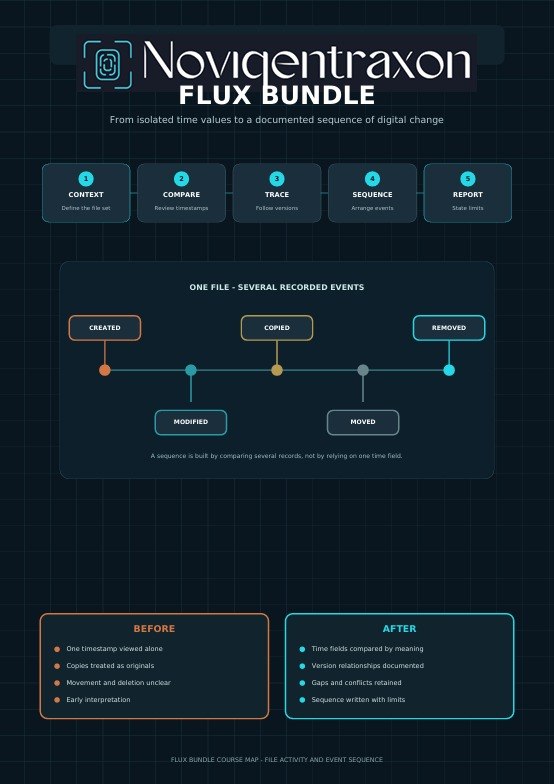
The Flux Bundle focuses on change, sequence, and movement within digital evidence. It introduces methods for reviewing file activity, comparing timestamps, tracing basic data changes, and connecting individual records to a wider event timeline.
Learners examine how digital information can develop across different stages. The course explains why one timestamp rarely provides a complete answer and how multiple records can be compared before forming a conclusion.
What’s Inside
The Flux Bundle includes structured lessons, timestamp comparison exercises, file-history scenarios, activity-mapping worksheets, evidence review tasks, and guided case studies.
Learners explore common timestamp categories, file naming patterns, copied and moved data, deleted-item indicators, and relationships between related files. The course also introduces sequence analysis, where several small records are arranged to describe how an event may have developed.
Practical exercises include comparing file details, identifying changes between records, documenting uncertain information, and preparing a chronological activity summary.
Who Is This For?
This tier is intended for learners who already understand evidence organization, investigation planning, and basic timeline development.
It is suitable for Digital Forensics students, security learners, technical support staff, internal review teams, compliance personnel, and anyone who wants to improve their understanding of file activity and event sequencing.
What You’ll Learn
-
Identify common file activity details
- Compare created, modified, and recorded timestamps
- Explain why timestamps may differ
- Recognize patterns in file names and locations
- Identify relationships between original and copied files
- Document file movement and modification
- Review indicators linked to deleted information
- Arrange digital activity into a chronological sequence
- Compare several records before forming an interpretation
- Separate confirmed changes from possible explanations
- Identify timeline conflicts and missing periods
- Connect file activity to investigation questions
- Prepare a structured change summary
- Record uncertainty using neutral language
- Review evidence without altering the original materials
- Present sequence-based findings clearly
Guarantee
The Flux Bundle is covered by a 30-day money-back policy. Learners may review the course materials and submit a refund request within 30 days when the request meets the conditions described in the store’s refund policy.
The course is presented as risk-free within the stated refund terms. Eligibility details, request procedures, and applicable conditions are explained in the published policy.
Certification
The course includes a certificate of completion, giving learners a clear way to confirm their progress and showcase their achievement.
How are the Noviqentraxon course tiers organized?
How are the Noviqentraxon course tiers organized?
The course tiers follow an ascending structure. Each level introduces additional topics, learning materials, practical exercises, and investigation scenarios. Learners can begin with foundational concepts and continue toward more detailed Digital Forensics subjects.
Do I need previous Digital Forensics knowledge?
Do I need previous Digital Forensics knowledge?
Previous knowledge is not required for the introductory tiers. The materials explain terminology, investigation principles, evidence-handling procedures, and documentation methods in a structured order. Later tiers introduce more detailed analytical tasks.
How are the courses delivered?
How are the courses delivered?
Each tier includes organized lessons, written explanations, practical examples, review activities, and supporting resources. Learners can study the materials at a pace that suits their schedule.