Noviqentraxon
Frame Set
Frame Set
Couldn't load pickup availability
- 📄 Digital file available after purchase
- 🗂️ Long-term availability
- 🔒 Secure checkout
- 📅 Content updated in 2026
Self-paced learning overview
Problem Statement
As learners move beyond introductory investigation planning, they often encounter a new challenge: organizing different forms of digital evidence into one readable case structure. Files, timestamps, account activity, device records, communication logs, and system events may all relate to the same incident, but they rarely appear in a clear sequence.
Without a consistent framework, learners may focus on isolated details rather than the relationship between events. Notes can become fragmented, evidence references may be difficult to trace, and important gaps may remain unnoticed.
Solution
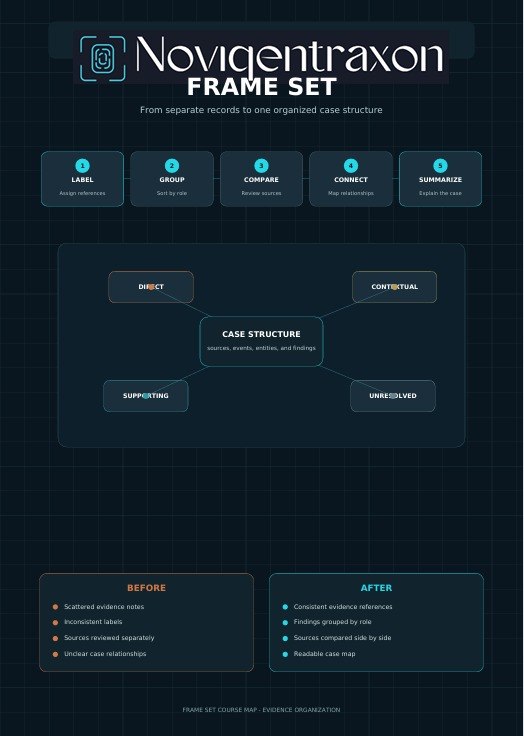
Learners practise grouping evidence by source, event, relevance, and time. The course explains how to compare records, identify repeated details, locate inconsistencies, and connect separate findings without making unsupported conclusions.
The materials also introduce case structure, evidence mapping, timeline refinement, and analytical review. Each topic is presented through guided examples that show how individual findings can be placed within a wider investigative frame.
What’s Inside
The Frame Set includes detailed lessons, evidence-mapping exercises, case-organization worksheets, timeline activities, comparison tables, investigation scenarios, note-review tasks, and reporting examples.
Learners examine how to create evidence categories, assign clear references, and connect findings to specific investigation questions. The course also covers the difference between direct findings, supporting findings, contextual information, and unresolved details.
Practical activities guide learners through reviewing a fictional case, comparing evidence sources, identifying missing information, and preparing a structured case overview.
Who Is This For?
This tier is intended for learners who understand basic Digital Forensics terminology, evidence preservation, and investigation planning.
It is suitable for students, security learners, technical staff, compliance teams, internal reviewers, and people who want to improve how they organize and explain digital findings.
What You’ll Learn
- Build a structured digital case file
- Group evidence by source, event, and relevance
- Create consistent evidence reference labels
- Compare information from different digital sources
- Identify matching and conflicting details
- Refine an activity timeline using multiple records
- Distinguish direct evidence from contextual information
- Connect findings to investigation questions
- Identify missing records and unresolved gaps
- Record alternative explanations without treating them as facts
- Create an evidence relationship map
- Review investigation notes for clarity and consistency
- Prepare a structured case overview
- Write concise evidence summaries
- Present findings in a logical sequence
Guarantee
The Frame Set is covered by a 30-day money-back policy. Learners may review the included course materials and submit a refund request within 30 days when the request meets the conditions stated in the store’s refund policy.
The course is provided on a risk-free basis within the published refund terms. Eligibility requirements, request procedures, and applicable conditions are described in the refund information.
Certification
The course includes a certificate of completion, giving learners a clear way to confirm their progress and showcase their achievement.
How are the Noviqentraxon course tiers organized?
How are the Noviqentraxon course tiers organized?
The course tiers follow an ascending structure. Each level introduces additional topics, learning materials, practical exercises, and investigation scenarios. Learners can begin with foundational concepts and continue toward more detailed Digital Forensics subjects.
Do I need previous Digital Forensics knowledge?
Do I need previous Digital Forensics knowledge?
Previous knowledge is not required for the introductory tiers. The materials explain terminology, investigation principles, evidence-handling procedures, and documentation methods in a structured order. Later tiers introduce more detailed analytical tasks.
How are the courses delivered?
How are the courses delivered?
Each tier includes organized lessons, written explanations, practical examples, review activities, and supporting resources. Learners can study the materials at a pace that suits their schedule.