Noviqentraxon
Luma Series
Luma Series
Couldn't load pickup availability
- 📄 Digital file available after purchase
- 🗂️ Long-term availability
- 🔒 Secure checkout
- 📅 Content updated in 2026
Self-paced learning overview
Problem Statement
At this stage of Digital Forensics study, learners may understand individual evidence sources, timelines, and relationship mapping but still find it difficult to review a larger case with several connected events. Complex investigations often contain repeated actions, overlapping timelines, multiple devices, and records that appear important only when compared with other findings.
The main challenge is maintaining a clear analytical structure while working with a growing amount of information.
Solution
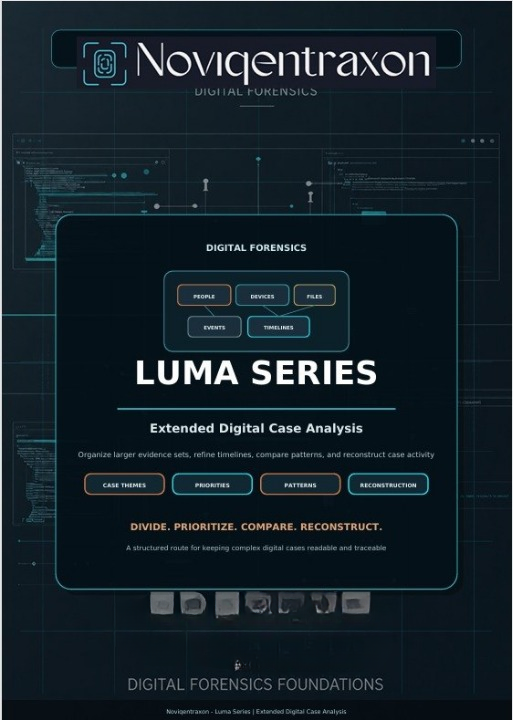
The Luma Series develops a structured approach to extended case analysis. It helps learners divide a larger investigation into manageable sections while keeping every finding connected to the original case questions.
The course introduces review stages, analytical checkpoints, evidence prioritization, and case reconstruction. Learners practise examining patterns across several sources, refining event sequences, and recording how their understanding of a case changes as new information is reviewed.
What’s Inside
The Luma Series includes extended case scenarios, evidence-priority worksheets, analytical review tables, reconstruction exercises, timeline refinement activities, relationship maps, and detailed reporting tasks.
Learners work through a fictional investigation containing multiple users, devices, file groups, activity records, and communication details. The course guides them through dividing the case into investigation themes, comparing related evidence, identifying recurring patterns, and recording unresolved questions.
The materials also introduce case-review checkpoints that help learners evaluate whether their notes, references, and findings remain consistent throughout the investigation.
Who Is This For?
This tier is intended for learners who have studied investigation workflows, multi-source review, evidence correlation, and relationship analysis.
It is suitable for Digital Forensics students, technical investigators, compliance teams, internal reviewers, security learners, and people who want to develop a more organized method for examining extended digital cases.
What You’ll Learn
- Divide a complex investigation into manageable review sections
- Prioritize evidence based on investigation questions
- Track findings across several evidence categories
- Refine timelines as additional records are reviewed
- Identify repeated actions and recurring activity patterns
- Compare several possible event sequences
- Build a structured case reconstruction
- Record how new findings affect earlier interpretations
- Identify contradictions between evidence sources
- Maintain consistent evidence references
- Create analytical review checkpoints
- Separate confirmed findings from unresolved possibilities
- Document gaps that require additional examination
- Connect detailed findings to the wider case context
- Prepare an extended investigation summary
- Present a complex case in a clear and readable format
Guarantee
The Luma Series includes a 30-day money-back policy. Learners may review the course materials and submit a refund request within 30 days when the request meets the conditions described in the store’s refund policy.
The course is offered on a risk-free basis within the published refund terms. Eligibility requirements, submission steps, and applicable conditions are explained in the refund information.
Certification
The course includes a certificate of completion, giving learners a clear way to confirm their progress and showcase their achievement.
How are the Noviqentraxon course tiers organized?
How are the Noviqentraxon course tiers organized?
The course tiers follow an ascending structure. Each level introduces additional topics, learning materials, practical exercises, and investigation scenarios. Learners can begin with foundational concepts and continue toward more detailed Digital Forensics subjects.
Do I need previous Digital Forensics knowledge?
Do I need previous Digital Forensics knowledge?
Previous knowledge is not required for the introductory tiers. The materials explain terminology, investigation principles, evidence-handling procedures, and documentation methods in a structured order. Later tiers introduce more detailed analytical tasks.
How are the courses delivered?
How are the courses delivered?
Each tier includes organized lessons, written explanations, practical examples, review activities, and supporting resources. Learners can study the materials at a pace that suits their schedule.